Quick take: On October 22 the DEA's chief administrative law judge refused to reopen the federal marijuana rescheduling hearing. Opponents wanted more testimony; he gave them ten pages of written argument instead, due October 29 with replies November 5. After that comes his recommendation. For Oklahoma medical licensees the big change already happened in April, when state-licensed medical products moved to Schedule III and the 280E tax penalty came off them. This week's ruling is about the rest of the plant, and about not losing another year.
I have been following this docket the way some people follow a playoff series, because the outcome decides whether a processor like ours can deduct rent and payroll like every other business in Guthrie. Here is what happened this week, what it does and does not change, and the dates to put on the wall.
What the judge decided
The hearing on moving marijuana from Schedule I to Schedule III ran from June 29 to July 15 this summer in front of DEA Chief Administrative Law Judge Derek C. Julius. After it closed, a group of rescheduling opponents (DUID Victim Voices, Dr. Kenneth Finn and the National Drug and Alcohol Screening Association) asked him to reopen it. Their reason was a Government Accountability Office report published September 23 that looked at how DEA and FDA divide up the job of scheduling drugs. They wanted new testimony and new discovery on HHS's 2023 medical-use analysis and on FDA's standards for abuse potential.
Julius said no. His order points out that the record already holds more than 2,500 pages of witness testimony and thousands of pages of exhibits, and that the requests were either outside the scope of the hearing or already covered. What he did allow is narrow: the GAO report goes into the record, and each side may file an optional brief of up to ten double-spaced pages on two questions only. How much weight should the report get, and if it gets any, are the policy gaps it describes big enough to matter to this proposal?
The dates: initial briefs due October 29, 2026. Replies due November 5, 2026. The stay on the proceeding ends on its own when briefing closes. There is no deadline on the judge's recommended decision.
What the GAO report actually says
Less than the headlines suggest. GAO found that DEA's scheduling decisions have generally lined up with HHS's recommendations, and that both agencies need more complete written policies describing who does what. That is a process critique, not a finding that cannabis belongs in Schedule I. The judge did not treat it as undermining the proposal. The briefs are the place to argue whether it should.
DEA's own lawyers had already told the judge last week that reopening would be a mistake and that the process should move to a decision. When the agency that enforces the Controlled Substances Act is the one asking to hurry up, the center of gravity has shifted.
How we got here
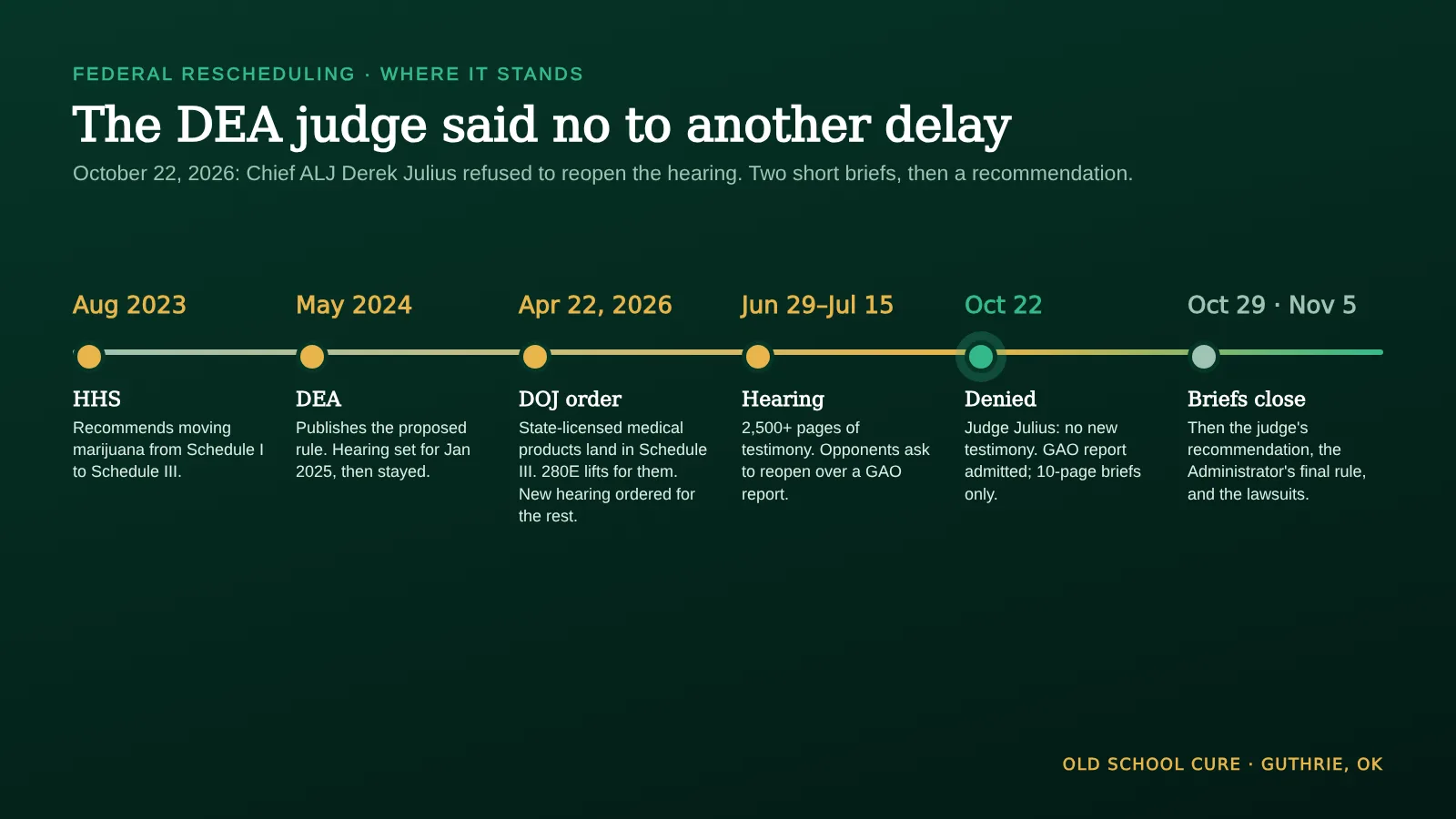
- August 2023. HHS recommends Schedule III after reviewing the medical and scientific evidence.
- May 2024. DEA publishes the proposed rule. A hearing is set for January 2025 and then stayed over who gets to participate.
- April 22, 2026. The Department of Justice issues a final order under 21 U.S.C. 811(d)(1). FDA-approved marijuana products, and marijuana covered by a state medical license, move to Schedule III. Everything else, including adult-use product and synthetic THC, stays in Schedule I. The order creates a federal registration path where a state license counts as proof of authorization, and it directs a new hearing on the rest.
- June 29 to July 15, 2026. That hearing runs. In practice the witness list was almost entirely opponents.
- October 22, 2026. Motion to reopen denied. Briefs only.
What this means for an Oklahoma processor
Three things, in order of how much they matter to the people I sell to.
280E. Section 280E of the tax code bars anyone "trafficking" in a Schedule I or II substance from deducting ordinary business expenses. You can deduct cost of goods sold and nothing else. For a hash maker that means the fresh frozen, the bags, the labor in the wash room count, while the rent on the building, the delivery van, the insurance and the bookkeeper do not. The April order took state-licensed medical marijuana out of Schedule I, and the legal analyses I have read agree that 280E stops applying to those operations from that date. The order even asks Treasury to consider relief for prior years, though that line has no legal force. Oklahoma is a medical-only state, which puts us in the cleanest position in the country on this. Operators in dual-license states that cannot separate medical from adult-use books are still arguing with their accountants.
Federal registration. The April order lets a state licensee file for DEA registration with the state license as conclusive evidence of authorization, and tells DEA to grant it unless doing so would be against the public interest. Applications filed in the first 60 days get a six-month processing clock, and early filers may keep operating on the state license while they wait. We filed ours in the spring and are waiting like everyone else. Registration dies automatically if the state license lapses, which is one more reason to keep your OMMA renewal tidy.
This week's ruling. It does not change what is in Schedule III today. What it does is keep the broader proposal moving toward a recommended decision instead of parking it for another round of testimony. A clean, closed record also matters later: whatever the Administrator finally signs will be sued over, and the less there is to pick apart procedurally, the better it holds.
What still has to happen
- Briefs close November 5.
- Judge Julius issues a recommended decision. No date; prior DEA hearings of this size have taken months.
- The DEA Administrator publishes a final rule, adopting, modifying or rejecting the recommendation.
- Litigation. Expect challenges from the same groups that filed this motion.
None of that touches the Oklahoma medical market's current Schedule III status, and none of it is a federal legalization of anything. Interstate commerce, banking and the FDA's view of our products are all separate fights.
The April order moved the money. This week's order kept the clock running.
Where to watch: the DEA hearing docket, the OMMA News page for anything the state does in response, and your tax professional, who should already be treating medical operations differently for 2026. If you buy from us and want to compare notes on how we are handling registration and books, text me. Every current pressing is on the live menu.